Tennis Band Alright Were Here Again
The troubled tale of Ten Years After: from Woodstock to the world
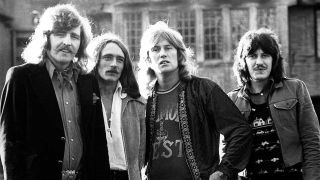
It was getting night by the time X Years Afterward took the phase at Woodstock dorsum in 1969. The rain had come bucketing down mid-way through the afternoon, but as they'd been about to go on, drenching the stage and turning the site into a quagmire.
The audience – variously estimated at betwixt 350,000 and 500,000 – was wet, chilled and bedraggled; many of them were the worse for wear after three days in the open up. The band weren't in much better shape, having travelled overnight from St Louis, making the last leg past helicopter and then existence cooped upwardly on-site in the back of a trailer, waiting for the pelting to terminate.
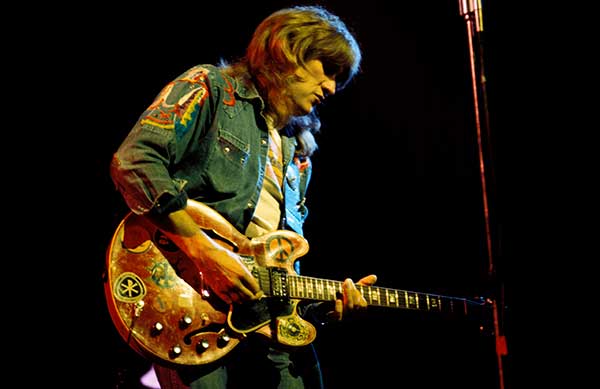
In the movie of Woodstock, the photographic camera picks out the skinny frame of TYA's Alvin Lee, his adolescent confront ringed by shoulder-length blond pilus. "This is a thing called 'I'm Going Home'… past helicopter!" he announces, and for a dozen seconds he rattles out notes on his trademark Gibson guitar that sound like a sustained burst of motorcar-gun fire.
The band and then kick into a breakneck boogie and the song takes off; Alvin spits out the vocals, filling in the spaces with more than guitar salvos. The camera remains fixed on him; there are but occasional glimpses of keyboard player Chick Churchill, drummer Ric Lee (no relation) and bassist Leo Lyons, who is headbanging furiously. Alvin leads the vocal high and low, never letting the pace flag, until nine minutes later he builds to a final warp-speed cacophony.
The oversupply, their primal heating now restored, erupts.
When the Woodstock moving-picture show came out in belatedly 1970 (more than than a year after the festival) it did for X Years Later what Live Aid did for Queen and U2: transformed them into superstars. Suddenly TYA were the new heroes of British blues stone. Or, every bit Alvin puts it: "That's when 14-twelvemonth-former girls started showing up to our gigs with ice-creams."
Ten Years After had been in the vanguard of the 2d (heavier) invasion of the U.s. by British groups, touring relentlessly and rapidly reaching pinnacle-of-the-bill status. "We had this thing – and looking dorsum I'm a fleck ashamed of it now – that we had to sting any band that went on after us," Alvin recalls. "We used to go out of our way to blow them off and make them wait bad.
"It wasn't so much playing well as going down well; nosotros'd learnt that from our years on the club circuit. And there were a lot of bands in America who wouldn't go on later on us. At Woodstock, Country Joe whipped his equipment on before us because he'd played afterwards us at the Fillmore East and died a death. We used to clothing the audiences out. It really was a heads-down-let'southward-go-for-information technology attitude. Leo used to shake his head off. That was fine on stage, but he'd do it in the studio, besides. We used to have to gaffer-record his headphones to his head."
Leo's headbanging manner even got him an offer from Frank Zappa to appear in a pic he was planning called The Choreographers Of Rock 'Due north' Roll. And the bassist reveals the hush-hush of TYA's vigorous alive shows: "Ric and I egged each other on when we flagged. I'd yell: 'Hit 'em, you bastard!' And he'd shout dorsum: 'Fuck off.'" Leo would also spur Ric on by spitting at him – anticipating the punk movement by a decade – just the drummer never minded "because he ever missed".
Riding the crest of this loftier-energy wave, Alvin would sneer and pout outrageously equally he tore through solo later solo. Fifty-fifty on the slower songs his bursts of notes seemed faster than mere homo fingers could manage. No wonder the American media dubbed him Captain Speedfingers.
But behind the blowing that had propelled Ten Years After into the premier league was some other, more than insecure Alvin who couldn't handle the superstar status that the Woodstock movie had bestowed on the group: "Nosotros'd been playing for the heads, the growing underground audience," he recounts. "Only and so information technology got bigger, and people had to come up to ice hockey arenas and stadiums to see the band. And we lost any contact with the audition.
I often wonder what the rest of our career would have been like if the Woodstock moving picture had used another song
Alvin Lee
"You had law with guns, and cotton in their ears, sneering at the ring and looking for half a run a risk to shell up the audience. Information technology was awful. It had all gone incorrect and I was thinking, what the fuck am I doing hither?"
And the song that had made 10 Years Afterwards famous was becoming an boundness: "You lot'd walk on stage and people would be shouting for I'grand Going Home, which was the last song. I often wonder what the rest of our career would have been like if the Woodstock picture show had used another song. As it was, everything became focused on the concluding song, the high-energy number."
To make matters worse, Alvin was also becoming estranged from the rest of the band: "I think they began to resent me because I started to back off and so," he admits. "I couldn't assist it, I hated it. I used to go on stage and go: 'dong!' [mimes a big chord] and the audience would go: 'Yeahhh!' You could do anything. It was but crazy. Information technology was horrible.
"My problem was that I couldn't communicate it to anybody. The ring thought I was looney. I went into sulks and things similar that. Maybe I should take tried to talk more with them, but information technology didn't work for some reason. They started to get jealous considering they thought I was existence singled out to do all the interviews and the photograph sessions. I wasn't getting singled out. I was the songwriter, singer and lead guitarist, after all, so obviously I was the i they wanted to talk to."
There was indeed resentment from the rest of the band. Only it was born out of frustration rather than jealousy. Around the fourth dimension of Woodstock, TYA'due south management had decided to focus all the attention on Alvin. Off-white plenty, you might think, equally Alvin was the frontman, guitar hero and pin-up. Only Ric and Leo believed Alvin was temperamentally unsuited to the part: "I felt information technology would be as well much force per unit area for Alvin, and told our manager, Chris Wright, that he was creating a monster he couldn't control," Leo says.
Their misgivings were well-founded. At the very moment that Ten Years After should take been seizing the initiative, they were in fact losing the plot. On his ain admission, Alvin retreated behind a wall of dope smoke. Whenever Ric and Leo, aroused at being marginalised, managed to provoke a reaction out of Alvin it was invariably the wrong ane. Information technology created a rift. And the recriminations continuing to this day.
What added to the bitterness was how close the group members had been upwardly to then. Ric describes Alvin and Leo's relationship as "a well-oiled marriage". Information technology dates back to 1960 when Leo started playing with Alvin, already a precocious guitarist, in local Nottingham band The Jaybirds. They even went through the classic 60s rock grouping apprenticeship together, playing a 5-week stint at Hamburg's Star Guild in 1962 – simply a week subsequently The Beatles.
"Nosotros stayed in a two-room apartment to a higher place a mud-wrestling/sex club," Ric remembers. "The rooms were filled with bunks, and at that place were probably 10 or 12 people living there. I was eighteen, Alvin was 17, and we were exposed to prostitutes, pep pills and music 24 hours a mean solar day."
Alvin confirms that the Hamburg experience was "a real rite of passage. One 24-hour interval I went into the bathroom and there was 1 bloke sitting on the toilet, a guy in the bath and some other guy washing his socks in the bath water. And all suddenly another bloke runs in and fires a gas gun into the room. Information technology was madness. There was likewise a scary side to it with the gangsters. I guy had this big welding glove, and when you used to see him going out with it you'd remember: 'Uh-oh, trouble'."
When the band returned to England, Alvin bought his beginning Gibson ES335 – which would get his trademark guitar. Ric, who came from nearby Mansfield, replaced the previous drummer in 1965, and soon afterwards they brought in Chick Churchill on keyboards. The following year they started borer into the burgeoning blues market place in Britain that John Mayall had opened up.
"I threw myself headlong into that," says Alvin, who had grown upward listening to his dad'due south collection of pre-war bluesmen such as Large Bill Broonzy, Lonnie Johnson and Josh White. But the jazzier influences in the group meant they were always, as Ric says, "a scrap sideways-on to the blues".
That paid off when Chick got them an audition for London'southward then legendary Marquee Club early in 1967, and every bit legendary club manager John Gee was impressed past their version of Woody Herman'southward 'Woodchopper'southward Ball'. To celebrate, they inverse their name from the now outdated Jaybirds to Ten Years Afterward – which Leo found while flicking through the pages of the Radio Times.
Via the Marquee, TYA landed a spot on the 1967 Windsor Jazz & Dejection Festival (which later became the Reading Festival), and got a standing ovation there in front of 20,000 people. Amongst them was noted dejection producer Mike Vernon, who was at that place checking out one of his charges, Fleetwood Mac. Vernon later signed Ten Years Later to Decca's new Deram label (ironically, the ring had recently failed an audition for Decca).
In keeping with the times, TYA slapped down their first album inside five days. "Mike could run into we were a bit radical equally far as his kind of blues was concerned," Alvin recalls, "but he basically gave u.s. the freedom and said go on with it." The album caught TYA'due south raw, jazzy approach to the blues, which could exist loftier-velocity, as on the opening I Want To Know, or wearisome, extended and mood-edifice, on the closing Help Me.
The record was crude and ready, but it attracted the attention of famed American promoter Bill Graham, who was looking for new bands to play his Fillmore venues in San Francisco and New York and figured there must exist more than where Cream and Hendrix had come up from.
In June 1968 Ten Years Subsequently started a vii-week US bout at the Fillmore Due west: "That first tour was great," Alvin recalls. "We had such a good time out there. Nosotros lost around $35,000, but we got asked dorsum then we knew nosotros were on the way. The foreign thing was that nosotros had gone to what I considered to exist the home of the blues but they'd never heard of most of them. I couldn't believe it – 'Big Bill who?' We were recycling American music and they were calling information technology the English language sound. And the American bands all had Fender equipment, which sounded actually tinny compared with the juicy sound you lot become from Marshalls."
We were recycling American music and they were calling it the English sound
Alvin Lee
Then, of course, there were the psychedelic delights of the Westward Coast. TYA had already been function of the London underground scene during 1967'southward Summer Of Dear; they had even fabricated a whimsical, trippy unmarried in early 1968 called Portable People, and played at the hip Middle World.
Publicity shots of the time reveal TYA'south garish fashion sense: "Ah, Paisley shirts!" Alvin laughs. "That was my girlfriend, Lorraine. She was the wild one. She had me wearing my female parent'southward curtains for trousers, with those lampshade frills round the bottom.
"I loved the cloak-and-dagger," he says. It was so experimental. Everything opened up, you lot could try anything. And past now the drugs were taking effect. That was all role of it – the opening of consciousness."
In America, you had to be careful not to find your consciousness expanded unwittingly. "There was ane gig at the Fillmore West," he remembers, "where somebody gave me this joint every bit we were going on stage. And I, Mr Bravado, had to have a toke. And it turned out to be angel grit. Past the time I got to the phase my left leg felt a mile long. I hit the starting time note on my guitar, and it struck the back of the hall and I saw information technology bounce back hitting the heads of the audience and ricochet upwardly into the roof.
"And I was merely standing there going: 'Wow'. I don't know how I managed to play, only I noticed at one point the band were looking at me strangely. After we finished the vocal I said: 'What'southward wrong?' And they said: 'Nosotros just did the same song twice!'. Just the audience were in the same state. It didn't seem to matter."
Needing a new anthology to promote, TYA hastily recorded a live anthology at a guild called Klook's Kleek in London. Undead caught the sweaty, pocket-size-club temper and the band's gratis-course arroyo to Won't Be Incorrect E'er and Woodchoppers Ball, the moody blues of Spider In Your Web and a younger but already potent I'thousand Going Dwelling.
"Basically, that album put it in a nutshell," Alvin reckons. "I was then happy with information technology. When I beginning heard it I idea, what are we going to exercise side by side? After that my mental attitude was, 'Allow'south go into the studio and experiment, because nosotros've already made the ultimate album'."
That'll be the non-and then-subtly titled Stonedhenge, then, Ten Years After's psychedelic blues anthology. "Pipes and stuff like that all over the place," is Alvin'south recollection. "But it was very experimental in places. I was into my musique concrete phase. At that place's quite a lot of [avant garde industrial composer] Todd Dockstader in in that location. It was still very clandestine at that point, and we were making music for that audition – for ourselves, really, because nosotros were that audience too."
After we finished the vocal I said: 'What's wrong?' And they said: 'We just did the same song twice!'
Alvin Lee
Stonedhenge could fairly claim to by TYA'due south nearly innovative album: light and trippy on the insistent Going To Try and the bouncy Hear Me Calling, a positively chilling on A Sad Song. And despite the substances the band were tight and confident.
Released in Feb 1969, the record set up Ten Years After for a momentous yr. In fact Woodstock was simply one of half a dozen festivals they played that summer, including Texas, Seattle and the prestigious Newport Jazz Festival – the only year rock bands were allowed in. At Flushing Meadow in New York they played alongside Vanilla Fudge and Jeff Beck.
Led Zeppelin also turned up to check out the competition. In Richard Cole'southward notorious Stairway To Heaven kiss-and-tell, the former Zeppelin tour manager relates how Jimmy Page was nonplussed by Alvin's playing. Much to the annoyance of an inebriated John Bonham, who suddenly lurched forward and threw a glass of orange juice over Alvin'southward guitar, slowing upwards his fingerwork as the strings and fretboard got stickier.
Alvin doesn't retrieve anything being thrown, although Ric confirms the story. He as well remembers a more than agreeable incident at the terminate of the show when he and Bonzo joined Jeff Brook for the encore: "In that location was Robert Found, Rod Stewart, Jimmy Page, Jeff Beck, and three bassists I think. Bonzo was beating out a riff on the drum kit, and so I grabbed a flooring tom and started thrumming hell out of it.
"The crowd were going apeshit as nosotros banged out a blues standard, and Bonham, who was already stripped to the waist, took off his trousers and underpants. He was sitting there naked, playing away. And the police saw him. And and then I saw Peter Grant and Richard Cole spotting the police force. The number fizzled out, and all I saw was Peter and Richard running on stage, each grabbing one of his arms, and his blank arse disappearing as they carried him off."
Alvin tended non to go involved in the stone'n'curlicue high jinks, however: "The reason I didn't mix with bands like Led Zeppelin and The Who too much and go in for all that hotel wrecking was that I was a doper; I was always conveying hashish effectually, and in those days you could get 12 years if you got caught with a joint in somewhere like Texas.
Fifty-fifty legal drugs such as alcohol could too exist chancy for Alvin, particularly if they were being brandished by someone similar Janis Joplin. "She used to chase me around a bit," he chuckles, "just I wouldn't have it. She was but too unsafe.
"There was a prove we did with them at the Fillmore East and they were handing her bottles of Southern Comfort on stage and she was drinking them. I thought information technology must exist something similar sweet wine. She came off stage and grabbed my ass and gave me a bottle. Then I drank information technology, and promptly complanate and passed out in a quiet corner. When I woke upwards information technology was well-nigh five in the morning and there was just some guy sweeping up. I didn't even know which hotel we were staying at."
In fact, on the Richter scale of stone groups behaving badly Ten Years Later on barely registered ("I tried to start a nutrient fight i nighttime, and everyone went: 'Behave yourself'," Ric admits). So it's something of a surprise to discover them actualization in the grossly overrated flick Groupie. In a scene that attempts to prove guilt by insinuation, Leo is seen with a young lady in a hotel coffee shop, ordering tea, while the soundtrack plays TYA's Good Morning Footling Schoolgirl.
"Oh boy, was my friend Iris pissed off when she saw the film," Leo laughs. "Someone sent me a copy recently, and I watched it while hiding behind the sofa with ane centre closed. Only it's pretty tame stuff at present. The musical segments are worth watching, but Spinal Tap would be a better buy for the backstage antics."

Information technology was TYA's Ssssh album, recorded simply before they embarked on their U.s.a. summertime tour in 1969 – that included Woodstock and the other festivals – that opened up the rift in the band. The album itself wasn't a trouble. After the laidback trip of Stonedhenge, Alvin was up and flight again; his baking solo on I Woke Up This Morn was a corker, and the reworked riff that anchors Skilful Morning Little Schoolgirl was tougher than the rest. The problem was the sleeve, which, in Ric's words, "stuck it to everyone. Nosotros'd done a photo session together, and all of a sudden we were presented with the anthology encompass with only Alvin on the forepart. And we went: 'What the fuck is this?'"
"This" was the new management strategy of putting the focus on Alvin. And Alvin admits the pressure got to him almost immediately: "In that location'southward this story virtually how I nearly didn't play Woodstock because I had a bad back. It wasn't a bad dorsum, information technology was a bad head. I couldn't face the tour. I looked at the xiii week list of dates and thought, I'g non going to get through this.
"I pretty much had a nervous breakup at the commencement of the tour. I'd washed five days of interviews earlier information technology started, I'd left my girlfriend dorsum in England, and I actually wasn't feeling very capable. I just complanate. Information technology was our American manager, Dee Anthony [who went on to manage Peter Frampton], who got me through information technology. He used to give me all these pep talks – 'Stay on the charabanc. It's your music. Forget all the bullshit. That 1 and a half hours on phase is all that counts'. But I was yet getting upset. I was still going on stage saying: 'This is horrible'."
Nevertheless, the relentless schedule connected – successfully, too. The 28 US tours they notched up between '68 and '74 was unequalled by whatsoever other British band. And the albums got bigger. Cricklewood Green (not quite equally exotic-sounding every bit Acapulco Gilded or Lebanese Black, admittedly, only and then the grass is always greener…), in 1970, cracked the American Top xx and was TYA'south biggest-selling UK album, helped past the hit single Honey Similar A Man. Alvin remembers writing most of the songs in the taxi on the way to the studio.
Watt, released at the terminate of the twelvemonth, failed to capitalise but Alvin finally got the fourth dimension he wanted to write songs for the next album, A Space In Time and came upward with the band's biggest striking, the deceptively simple, catchy but left-field I'd Beloved To Change The World. It was a crucial opportunity for the ring.
"But by and then I was too confused to take information technology," Alvin says. "'I'd Beloved To Change The World' was a hit, and I hated it considering it was a hitting. By and then I was rebelling. I never played information technology live. To me it was a popular song."
Even worse, Alvin vetoed the record company pick for the follow-up single, which annoyed the head of their Us label, the redoubtable Clive Davis, who had before told the band: "Requite me the tools and I'll practice the job", and promptly made I'd Love To Change The World a Top X hit.
Ric remembers beingness invited to a Columbia Records marketing meeting chaired by Davis, with all the radio promotions people maxim that Tomorrow I'll Exist Out Of Town was a perfect radio cutting. When Ric said the band didn't want that as a unmarried, Davis growled: "So why is that runway on the album? If you want me to do the task, don't requite me the tools and then accept them away from me."
"He'd been on our side upwardly until then," Ric says. "But after that the albums never sold equally well and we never had another hit. If the artists didn't co-operate, then the record company would simply move on to one that did; they weren't going to wait around for us to become our human action together. It was a lesson in reality."
Not that fifty-fifty Clive Davis could have done much with Rock And Roll To The World which was recorded and sold pretty much on auto pilot. And while Recorded Alive fared better, it also highlighted the fact that the cadre of the set up had remained unchanged since Woodstock four years earlier. "What's the indicate?" was Alvin's response. He didn't have the inclination, he was miserable, and communication inside the band was generally reduced to "shouting and screaming matches".
Leo contends that Alvin in turn fabricated the band's lives a misery: "It stressed me out so much that I stopped trying to reconcile things. I still enjoyed playing alive shows, provided there were no tantrums. If in that location were confrontations, I stupidly rose to the bait every time." Among such an temper, the management kept their distance.
Eventually TYA took a six-month break for the second half of '73. Alvin recorded a solo album with gospel singer Mylon Lefevre (who had supported them on tour) at his newly finished home studio. "Mylon was groovy. He arrived and said: 'Where do all the musicians hang out?' I told him the Speakeasy. He went straight off, and came back about six hours later and said: 'I got us a band.' And in walked George Harrison, Steve Winwood and Jim Capaldi! Mylon actually had a argent tongue. He captivated everyone."
Harrison even goaded Alvin into putting on his own gig. Alvin: "He said: 'I bet you lot couldn't.' And I did. I rang upwards and got a booking at the Rainbow Theatre. I had 24 songs that hadn't worked with Ten Years After, and I rehearsed them with a band that included Boz Burrell, Tim Hinkley and Mel Collins."
The titles of the Mylon Lefevre album (On The Road To Freedom) and Alvin Lee & Co'due south live In Flight both seemed to offer broad hints about Alvin'due south intentions. But, surprisingly, at that place was a new TYA album in 1974, Positive Vibrations. Except that it wasn't.
Alvin didn't seem to know what he wanted: "I did an American tour with Alvin Lee & Co. It was all new cloth; I didn't play 'I'yard Going Domicile' or any of that. We were playing picayune theatres, getting practiced reviews. But, to tell y'all the truth, I did miss the oomph of the audience. I'd got used to that. I mean, they enjoyed it and clapped and stuff, but there wasn't the oomph at that place. So I did a Ten Years Afterwards bout and got the oomph back."
Not for long, though. Another petulant spat resulted in a threat to put the band on wages. They limped through one more than US bout before information technology all disintegrated. Alvin then embarked on a solo career as Alvin Lee & Co, the Alvin Lee Band, Alvin Lee & 10 Years Later and even apparently old Alvin Lee. Meanwhile, the others got on with music-related careers – playing, sessions, producing, managing.
In 1983 Ric got a call from the Marquee presuming that Ten Years Later would be playing at the society's 25th ceremony celebrations. "I rang round the others and said: 'I think we should do this'."
Alvin felt "it showed us we could exercise it. And it was fun, really. We had i rehearsal in the afternoon, and then we plugged in and played and it was Ten Years After. That amazed me. And we thought that from that gig there would be a reunion. But it didn't happen. It was a funny fourth dimension in music. We weren't legends, we were old farts."
Ten Years Later on petered out when the bickering started upwards again. Information technology also hampered subsequent reunions at the stop of the 80s and the late 90s which included a cornball advent at the Woodstock 29th anniversary festival, billed as A Twenty-four hour period In The Garden. Their reactions to that are revealing.
Alvin: "It was a big disappointment. At that place I was, standing in a field that they tell me is exactly where information technology happened. Only the people weren't there, the vibe wasn't there. It had nothing to do with it."
Leo: "It turned out to be a series of flashbacks for me. We were booked into what used to be the Holiday Inn, Liberty – Tranquility Base in 1969. I didn't realise until I walked into the hotel bar. It stopped me in my tracks. I swear I could run across and hear Jimi, Janis, Jerry [Garcia], Bob [Hite], all of them gone now. We were together in that room 29 years ago."
Ric: "Disappointing, really. We hadn't played for a while. I was certainly rusty. The original thing was funky, this was all very clinical. It was similar an MOR concert. Still, at least we had dressing rooms, which we never had the first time…"
It was a funny time in music. We weren't legends, nosotros were old farts.
Alvin Lee
For TYA information technology all came to a head at the last of a serial of European festival shows in 1999. A savage spat between Leo and Alvin buried any reunion hopes under a mound of perceived grievances on all sides. Alvin went dorsum to his own ring, while the others remained together, occasionally playing and recording with various American guitarists.
Nevertheless, the success of some 10 Years After reissues – plus a fine previously unreleased 1970 prove at New York's Fillmore Eastward – prompted Ric, Leo and Chick to revive the band over again in 2002. After Alvin turned them downward once more, they went looking for a new guitarist and found one via Leo'south son, who told them nigh a "shit-hot" guitarist he'd known at schoolhouse, 25-year-old Joe Gooch.
"Initially I was sceptical considering of his historic period," Ric admits, "merely as presently as I saw him play I had no doubts." A couple of European dates convinced all of the band that Joe was the man to replace Alvin. "He has his own style just he tin can notwithstanding deliver all the Ten Years After hits," Ric says.
Alvin found the new 10 Years After situation "very sad. Ten Years After used to be a credible name and I was proud of it," the guitarist says. "Now it's merely an embarrassment. I asked them to change the name slightly, so equally not to misfile the fans, but they refused."
Alvin recorded an album with Elvis Presley'southward original backing musicians, guitarist Scotty More than and drummer DJ Fontana ("my teenage heroes") in Nashville, titled In Tennessee, besides reckons that "it's a shame the new guitarist, who must be pretty good to play my licks, is copying somebody else's style instead of playing his own music. If I had taken a task copying somebody else's music when I was starting out there would never have been a X Years After."
This feature was originally published in 2003, in Classic Rock 56. Alvin Lee died in 2013. Joe Gooch left Ten Years Afterward in 2014.
Source: https://www.loudersound.com/features/the-story-of-ten-years-after-from-woodstock-to-the-world
0 Response to "Tennis Band Alright Were Here Again"
Post a Comment